.png)


For most of the last decade, India's new economy was a private story.
These companies were built quietly. Valued behind closed doors by a small group of investors. A funding round would happen once a year, maybe twice, and that valuation would sit there as the only number anyone had to go by. There was no daily read on how these businesses were actually doing. No public benchmark. Just a snapshot, taken every so often, by people who already had a stake in the outcome.
Then, one by one, these companies started to list.
Explore the full Index - https://index.trifectacapital.in/
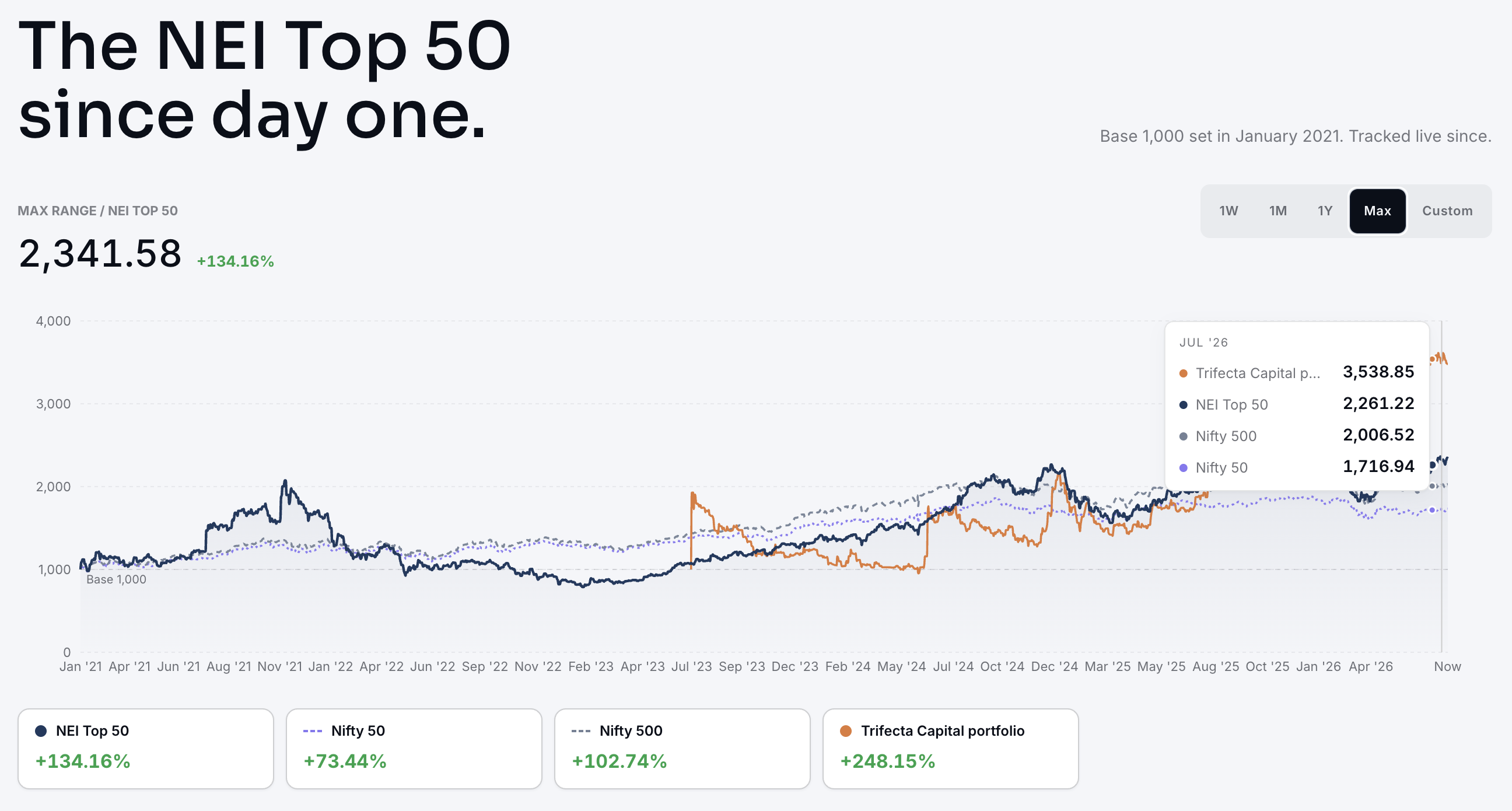
Zomato went public. Nykaa went public. PB Fintech, Policybazaar's parent, went public. And they were followed by dozens more, across sectors that a decade ago barely had names: quick commerce, D2C brands, vertical SaaS, digital lending. What we are watching right now is that entire private story turning public. And for the first time, it is not a handful of investors deciding what these companies are worth. It is the market, every single day, doing that job in the open.
We built the New Economy Index to keep an honest, running record of that.
We have been on this journey ourselves
Trifecta Capital has spent over 10 years backing India's new economy. More than $1 billion deployed, across 220+ companies, at a point when most of these businesses had no public track record at all. We were investing on conviction, on the founder, on the market opportunity, long before anyone could look up a stock price and settle the argument.
And we have not just been there at one stage. We have been present through the entire life of these companies.
We come in early with venture debt, often around the time a company is at Series A, when it does not yet have enough of a track record for equity investors to price it confidently. Our advisory business works alongside founders as they scale, helping them navigate things like regulatory and compliance requirements that come with growing fast. And when a company gets closer to going public, we come in again, this time with growth equity, right through the run-up to IPO.
Early stage all the way to public markets. That is the full arc, and we have been part of it for a decade.
So when we started asking ourselves how this cohort was actually performing now that the market gets to judge it, it did not feel like a new direction for us. It felt like the natural next question to ask, given everything we had already been doing.
What the index is actually asking
The New Economy Index is not really a sector index. It is closer to a map of how the Indian economy itself is shifting.
Value is moving. From banks to fintech. From traditional retail to quick commerce. From the old economy's largest, most established names to a new set of companies that did not exist, in any meaningful way, 15 years ago. Platforms, meaning consumer internet and commerce businesses, already make up more than half the index. Fintech and consumer brands come next. Every time a new company lists, another piece of that shift becomes visible and measurable.
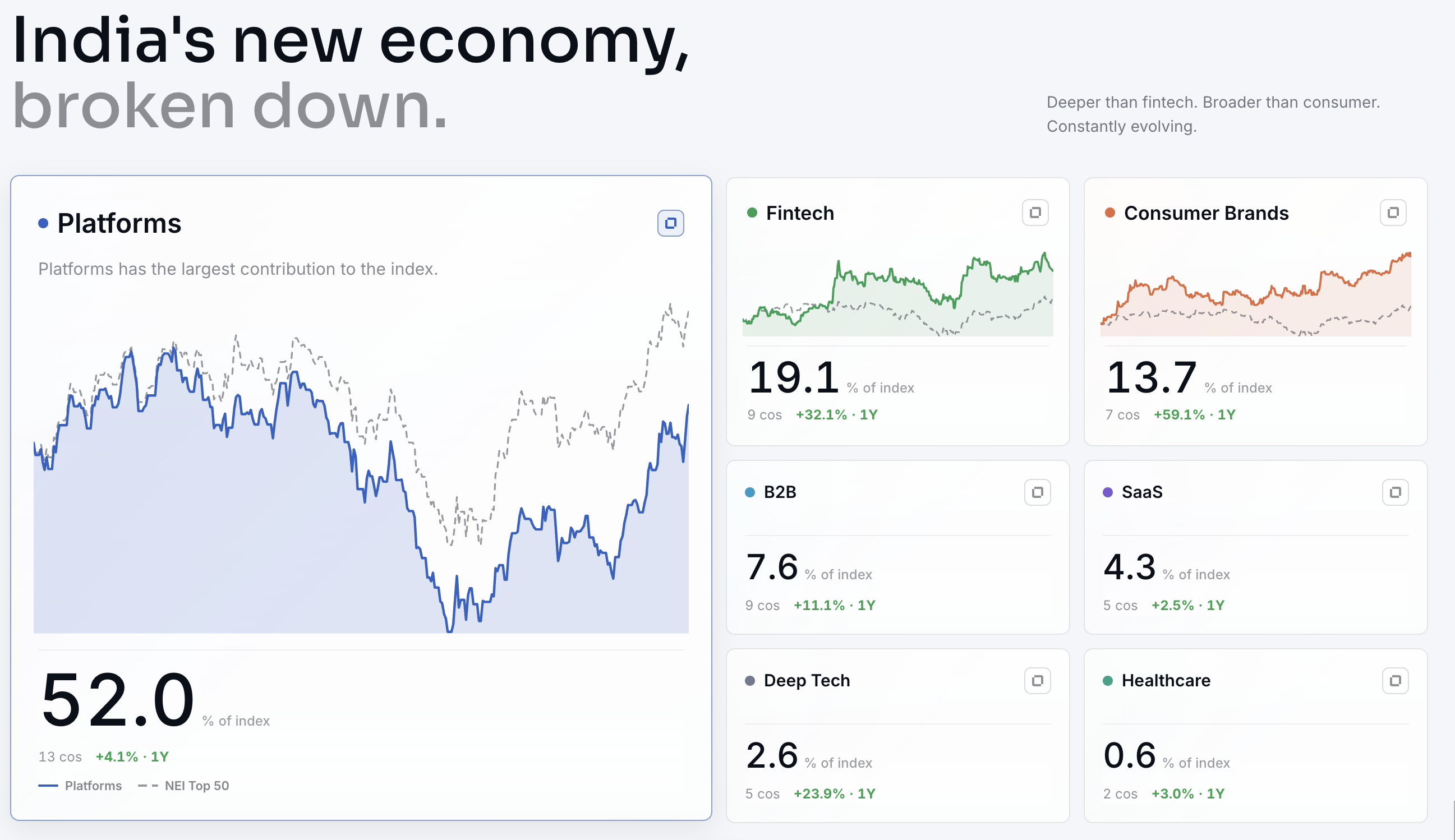
And the scale involved is no longer small. Together, the 50 companies in the index are worth well over $150 billion. That is roughly 3% of the total market cap of all Indian companies, built by businesses that, for the most part, did not exist a generation ago. These companies also touch an enormous number of people directly. A consumer platform in this index reaches over 270 million users. A digital lender in this index serves more than 60 million registered users, many of whom traditional banks were never really built to serve in the first place. This is not an abstract financial story. It is the everyday texture of modern life in India, now visible on a public exchange.
The unicorn story has changed
For years, India counted its unicorns almost entirely in the private market. Roughly 120 of them, by most estimates, all valued behind closed doors.
What has changed is that a meaningful part of that story has now crossed over into public markets. Over 30 companies in this index are worth more than a billion dollars each. A number of them are worth more than five billion dollars each. The billion-dollar club used to be a private-market badge, something you earned in a funding round and could not easily verify. Now, a real part of it trades in the open, where anyone can look up the price and own a piece of it if they choose to.
Why we think the cohort has grown up
An index number on its own can hide a lot. Any single company in this list, looked at alone, is noisy. A stock can have a rough quarter, a bad news cycle, a founder controversy. None of that tells you much about the sector as a whole.
But looked at together, across all 50 companies, the picture becomes a lot clearer. A large share of these companies trade above their IPO price today. A meaningful chunk have delivered strong annualised returns since listing. This is not one or two winners carrying the whole story. It is a broad, cross-sector pattern of companies that have, on the whole, held up well once the public market started pricing them daily.
That, to us, is the real signal. India's new economy has grown up enough to be judged the same way the rest of the market is judged, every day, in the open, without any special treatment.
And yet, we are still early
Despite all of this, most of these companies do not have much public history yet. A large share have been listed for less than three years. A meaningful number have been listed for under a year.
This is not a finished chapter we are reflecting on years later. It is a story being written from its very first page, right now. That is exactly why we built this index at this moment, rather than waiting and reconstructing the story a decade from now with the benefit of hindsight. We wanted a way to track the whole journey as it happens, not after the fact.
We have seen this pattern before, elsewhere
Every economy that goes through a serious wave of new-age company creation eventually gets its own benchmark for that wave. The Nasdaq did this for American tech. The Hang Seng Tech Index did this for Hong Kong.
India has reached a similar point in its own journey. We built the New Economy Index as a way to track that same coming-of-age, and to give everyone tracking India's new economy, whether they are investors, founders, journalists, or researchers, a shared, honest number to work with.
The Nasdaq was not built after America's tech story had already played out. It was built alongside it, and it grew as that story grew. We think of this index the same way. Not as a retrospective, but as a way to watch India's new economy come of age in real time, and keep an honest record of it as it happens.
Why us
We are not an outside party looking in on this industry from a distance. We backed many of these companies from their earliest days, sat on their boards, helped them think through capital structure decisions long before an IPO was even on the table, and stayed involved as they made the jump to public markets.
This index is built by a firm that helped create this asset class in the first place, tracking the full cohort, not just our own portfolio, because the goal was always a representative, honest picture of where India's new economy actually stands today.
That is why we built it.