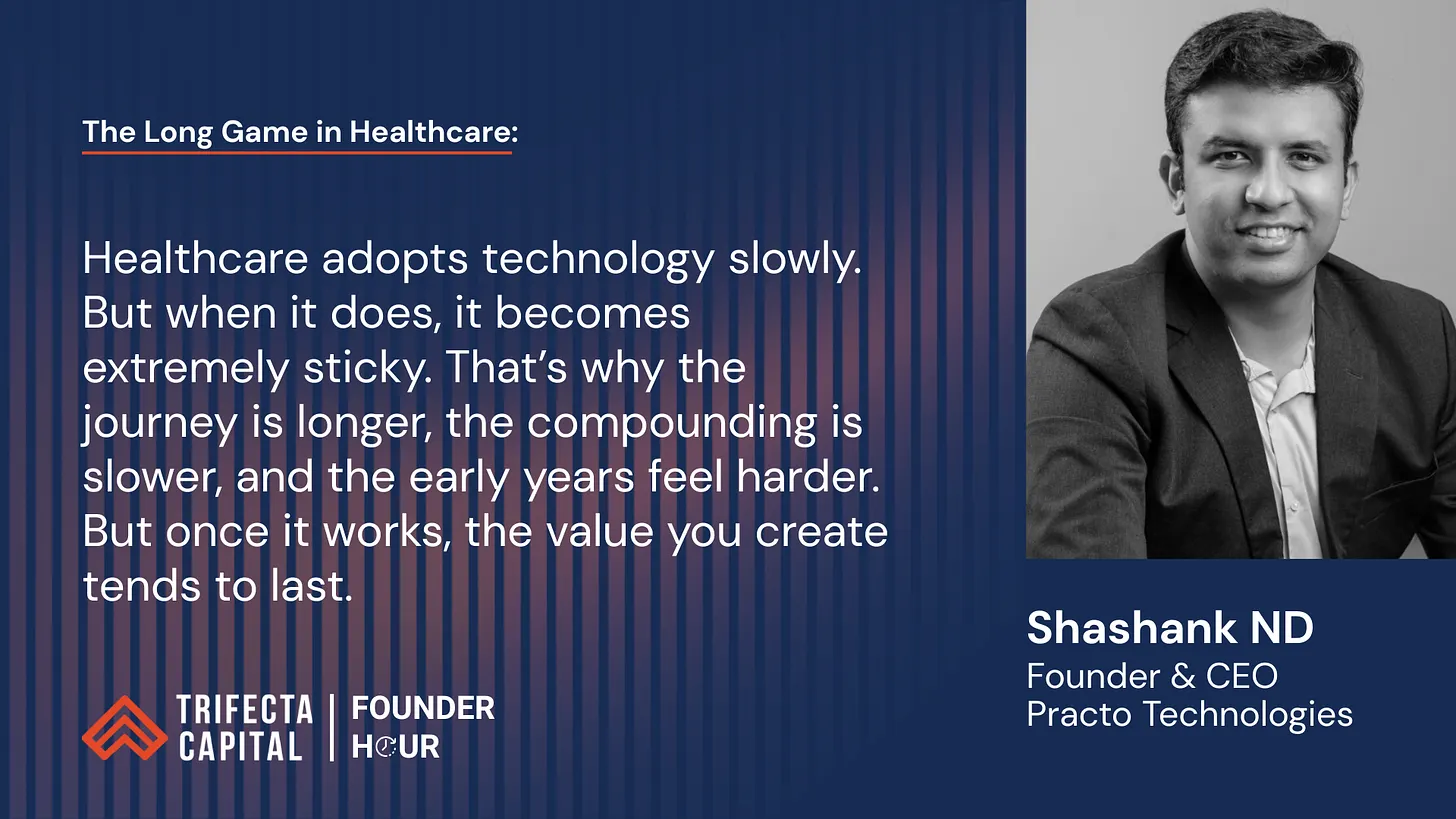


Arijit Sarkar, Partner, Trifecta Capital, in conversation with Shashank ND, Founder & CEO, Practo
This is the full transcript of the Founder Hour session featuring Shashank ND, Founder & CEO of Practo, in conversation with Arijit Sarkar, Partner at Trifecta Capital. The transcript has been lightly edited for clarity and readability, with care taken to retain the original context and intent of the discussion. For a condensed overview of the key insights and themes covered in this session, click the Summarize AI button available on your preferred platform.
Founder Hour is where we slow down and have the conversations that rarely happen in public. It's a space at Trifecta Capital to unpack what building a company actually takes — the decisions that don't make headlines, the trade-offs that compound quietly, and the moments that shape a journey over years. The intent is to step back and look at how sectors really evolve, where durable value comes from, and what actually compounds in the long run.
Key Takeaways
If you only have a few minutes, here's what investors, operators, and founders should take away from this conversation with Shashank.
- The problem was timing, not demand. Digital health wasn't an early-stage risk — it was early timing. Practo's experience shows that many healthcare startups struggle not because the idea is wrong, but because the ecosystem — regulators, providers, and incentives — isn't ready yet. COVID accelerated acceptance by years.
- The real scale was unlocked by regulation, not consumers. Consumer demand existed well before 2020. The real unlock came when regulators formalised telemedicine and providers began recognising digital platforms as core infrastructure rather than add-ons.
- Monetisation came late, but it stuck. User growth can come early, but profitable monetisation in healthcare takes significantly longer due to trust, regulation, and industry maturity. Once established, revenue is highly recurring and resilient.
- Trust was chosen, not optimised for. Practo consistently chose long-term trust over short-term revenue — from unbiased doctor rankings to strict quality audits. Trust is best understood as future revenue earned over time.
- AI works only after the basics are right. AI increased data depth and operational efficiency at Practo, but architecture, talent, and business model discipline remain the real constraints to scale. In healthcare, technology accelerates progress only after the foundations are sound.
Starting in 2008: Before Startups Were a Thing in India
ARIJIT: You started Practo in 2008, long before startups were mainstream in India. What motivated you to begin so early?
SHASHANK: I started in 2008 when I was in Suratkal, in my third year of engineering. At that point, there was no Startup India, no Flipkart, and startups were really not a thing. The campus itself wasn't very exciting, the curriculum was average, and I was trying to find other avenues to channel energy beyond what people usually do on college campuses.
Around the same time, my parents were in and out of hospitals, so I saw healthcare up close and started noticing how inefficiently treatment was delivered. One example that really stuck with me: my dad was diagnosed and needed knee surgery, and the doctor gave me a printed prescription. I asked why he couldn't email it. He said his software only had a print button. That got me thinking — even then I knew adding an email button was one line of code, yet because of that, people were carrying printouts, taking photographs, managing paperwork. It was personal because it affected my parents' lives. So I said: why don't I just build this.
I built a software called Ray. It took me about two weeks to code, written in PHP — and even today we still sell it. By the time I graduated, I had about a thousand paying customers on a SaaS model, roughly around ₹1 crore in annual revenue. My campus offer was around ₹10 lakh, but what really motivated me was the realisation that you could sit in your room, write code, and impact people's lives. That freedom was very liberating. That's how the journey started.
Key Inflection Points: Seven Years to Overnight Success
ARIJIT: When you look back at the first several years, what were the key inflection points in Practo's journey?
SHASHANK: People often think 2015 was the big success moment, but I see it as overnight success after seven years of hard work.
One very important inflection point was realising that the software market in India was actually quite small. We grew to about 20,000 clinics, but when you did the math, total revenue was around ₹20 crore — and beyond that the market was still very nascent. Software alone wasn't going to be enough to build a really large outcome.
So around 2012, I took two big bets. One was moving part of the business to Singapore and starting to sell healthcare SaaS globally. The second was building a consumer platform. Our vision was always consumer-first — mobile was taking off — and we asked whether we could help consumers find doctors and book appointments.
We launched the consumer platform inspired by OpenTable and RedBus, where B2B software feeds into a marketplace. That combination worked extremely well, and within about three years we reached roughly 150 million users annually. At that point, it became a grab-the-market situation — which meant raising capital to expand fast and consolidate competitors.
Cracking Doctor Adoption: First Principles and Free Listings
ARIJIT: Doctors are a very hard supply side to crack. How did Practo scale doctor adoption so effectively?
SHASHANK: One thing that really helped us was lack of experience. We never went into it thinking, "Oh my god, these are doctors." The problem found us and we just said we're all in. Even today it's extremely hard — which is why it's difficult to replicate — but because we didn't know how hard it was supposed to be, we approached it very naively.
We were very strong on first principles. For example, we launched free listings. Today free listings are not even a thing anymore, but the principle was simple: to gain the trust of consumers, you need the best doctors on the platform. If you make it paid from day one, the first people who come are average or low-quality doctors, and then your brand gets associated with that. So we kept it free to attract the best doctors first.
The second thing was data. Even before Google Maps and Google My Business became what they are today, in 2012 we had bike riders going lane by lane, mapping clinics and hospitals using GPS. That's why today we have the highest density of unique information on doctors and clinics in India. People think it's SEO, but it's really about data and first-principles thinking. Even globally, there's still no single platform for doctors and hospitals the way Booking.com exists for hotels.
The Early Sales Hustle: Dad's Shirt and Free Trials
ARIJIT: In the very early days, how did you convince doctors to use and pay for the product?
SHASHANK: In the early days, I was still in college. I used to wear my dad's shirt and carry a sales executive card. Doctors would look at the card and think that if the sales guy looks decent, the company must be big — and that helped more than you'd imagine.
I was also a very shy engineer who hated asking for money. Even today, I don't enjoy asking for money. So what I did was run free trials, track usage, and only go back to doctors who were actively using the product before asking them to pay. That made the conversation much easier.
What Made Practo Last: Being Married to the Problem
ARIJIT: Practo outlasted many competitors. What do you think made the difference?
SHASHANK: We were deeply married to the problem. Our motivation didn't come from competition, valuation, or capital raised — it came from wanting to solve the problem properly. Healthcare throws a lot at you: regulation, monetisation challenges, capital cycles, product complexity. You need a fire that's deeper than surface-level ambition.
Even today, what keeps us going is impact. Just yesterday, we detected a malignant tumour in the pancreas of a 60-year-old man who was completely asymptomatic — that probably saved his life. When you're driven by that kind of impact, you keep going.
The First Cheque: Sequoia, a Cold Email, and No PR
ARIJIT: Who wrote Practo's first cheque, and what convinced them?
SHASHANK: In 2010, I got a cold email from Shailendra Singh at Sequoia asking if it was true that we had a thousand paying SaaS customers. At the time, I was doing sales on local trains in Bombay. I went to meet him with bank statements and a slide listing all customers in very small font, and spoke non-stop for almost an hour.
He later called and said he'd write a ₹2 crore cheque — but with one condition: no PR. At that time, seed funding wasn't even really a concept. We took the money, and in six months we had 10x'd revenue. Once that happened, the market found out and we had multiple Series A term sheets.
The Adjacencies Phase: Too Much Capital, Lost Years
ARIJIT: Between 2015 and 2018, Practo tried multiple adjacencies. What did that phase teach you?
SHASHANK: Between 2015 and 2017, we honestly had too much capital and the business didn't need it. We tried to build a healthcare super app — e-pharmacy, diagnostics, logistics — but we underestimated the complexity and the fact that these adjacencies had very different underlying assets.
Those were lost years for us, both in terms of time and equity. In 2018, we did a cleanup, shut down non-core businesses, and refocused on doctors and providers. By the time COVID hit, we were back in our core — and telemedicine was already working.
COVID as Catalyst: When Regulators Changed, Not Consumers
ARIJIT: How did COVID change the trajectory of Practo and digital health more broadly?
SHASHANK: Digital health was simply too early in 2008. Before 2020, regulators and providers saw us as a nice-to-have. Telemedicine and online appointments were dismissed. When COVID happened, everything went digital — hospitals, clinics, doctors.
People think consumer behaviour changed, but it didn't. It was the regulators and providers who changed. Within one week of COVID, telemedicine regulations were released, and we went from being a potential ban case to a regulated entity.
Before that, we were actively harassed. Medical councils wrote to doctors on our platform threatening to ban them for practising online. Doctors lost income just for having their photographs listed. When I met regulators, they said we charged too much — we charged ₹100–200 on a ₹10,000 transaction, and even that was considered excessive.
After COVID, regulation eased and providers began seeing genuine value. Take rates moved from around 1% pre-COVID to 10–20% with hospitals today, and our provider business has compounded at 40–45% over the last four years.
Growth Cycles in Healthcare: Why It Takes Longer
ARIJIT: Healthcare businesses take longer to mature. How do you think about growth cycles in this sector?
SHASHANK: People often look at outcomes without accounting for inputs — and inputs include capital cycles. VC cycles are seven to eight years, and we've gone through two of them. User growth came early, but profitable monetisation came much later because industry maturity lagged.
For us, it took about 12 to 13 years. Healthcare adopts technology last, because the human body is complex and the stakes are high. But once it adopts, it's very sticky and very resilient.
Trust as a Business Model
ARIJIT: How important is trust in building a healthcare platform?
SHASHANK: Trust is everything. We verify doctor credentials, physically audit hospitals, and don't change rankings based on monetisation. We could generate ₹80 crore instantly by changing those rankings — but we don't.
We publish doctor reviews — positive and negative — even for paying customers. Internally, we follow a framework: Vision, User, Practo, Investor, Me. Trust is future revenue you choose to earn later.
What's Next: International Expansion, AI, and Corporate Health
ARIJIT: What excites you most looking ahead?
SHASHANK: International expansion is very exciting. We launched in the US and went from zero to $100 million GMV in six to nine months. India is around $400 million GMV and growing at 20–30% annually. We also launched in Dubai, where Practo now ranks first for dentist searches — and all our international growth is organic.
The second big area is AI-driven health outcomes. Four million consumers chat with our AI annually, and AI is improving fulfilment, scheduling, and outcomes across the platform. The third area is payers and corporate healthcare — a large, underpenetrated opportunity.
The Tech Debt Reality: 17 Years of Architecture Decisions
ARIJIT: How has your technology stack evolved over time?
SHASHANK: We have 17 years of tech debt. One frontend — JavaScript — and four backend stacks: PHP, Python, Ruby, and Java. It's a mess.
About 20 to 30% of our growth is currently constrained by technology. AI helped us go from 20 million to 120 million data points, but architecture is now the bottleneck. So we're increasing talent density. We've set up a second development centre in Hyderabad with about 50 engineers, and in Bangalore we're hiring senior talent to refactor and rebuild. About 40% of our roadmap today is re-architecting old systems for 10x efficiency.
Thank you, Shashank, for the candid conversation.
End of session